Reuse before recycle. Landfill never.
Sustainability isn't a department here — it's the reason the company exists. This is the pledge we make, and the data we keep to prove we're honoring it.
Need diversion data for your ESG report?
Tell us about your packaging streams and we'll show you the reuse-first numbers we can document for you.
- ♻ Landfill-free
- 48-hr quotes
- Nationwide freight
Our sustainability pledge is to keep packaging at the top of the waste hierarchy: prevent, then reuse, then recycle — and never landfill. In practice that means we resell and recondition boxes and Gaylords before we ever recycle them, turn genuinely spent board into plastic-free upcycled goods, supply ISPM-15 pallets, and hand our customers auditable diversion data for their ESG reporting.
We work the ladder from the top — always.
The waste hierarchy ranks options from best to worst for the planet. Most companies start thinking about it only at recycling. We start two rungs higher.
Buy nothing new that already exists
The greenest box is one already manufactured. We help customers source used before new, so a tree only ever pays once.
Resell and recondition first
Graded and reconditioned boxes go straight back into service — the highest-value, lowest-impact outcome, and always our first move.
Only what is truly spent
When board can no longer ship or be upcycled, we recycle it responsibly. Recycling is our floor, not our default.
Never
There is no fourth step for us. Landfill is designed out of the operation entirely.
Every reused box is a number we can defend.
Cumulative across 17+ years of reuse, reconditioning and recycling. See the live impact page.
The pledge, in practice.
A pledge is only worth the specifics behind it. Here is what ours commits us to on the dock, in the upcycling line, and in the reports we hand your team.
How a reused box avoids emissions.
The single biggest environmental cost in a corrugated box is not shipping it — it is making the board in the first place. Pulping virgin or recycled fiber, forming it, drying it and converting it into a box is where the water and energy go. Reuse avoids that step entirely for as long as the box keeps working.
So our impact math rests on two levers. First, prevented manufacturing: a reused box is a new box that never had to be made. Second, deferred reprocessing: every additional reuse cycle postpones the day that fiber has to be pulped again, and each pulping shortens the fiber and costs water and energy. We measure units and tonnage by grade as they move through the yard, so the avoided-emissions figure is anchored to actual throughput — not a flat industry multiplier.
| Outcome | Fiber cost | Relative footprint |
|---|---|---|
| Reuse as-is | None — same box, same job | Lowest |
| Recondition & reuse | Minimal — tape, trim, re-flap | Very low |
| Upcycle to dunnage | Reshaped, not re-pulped | Low |
| Recycle to new board | Full pulping; fiber shortens | Moderate |
| Buy new virgin box | New fiber, full manufacture | Highest |
Directional comparison of relative impact per box — reuse wins because it skips the step that costs the most.
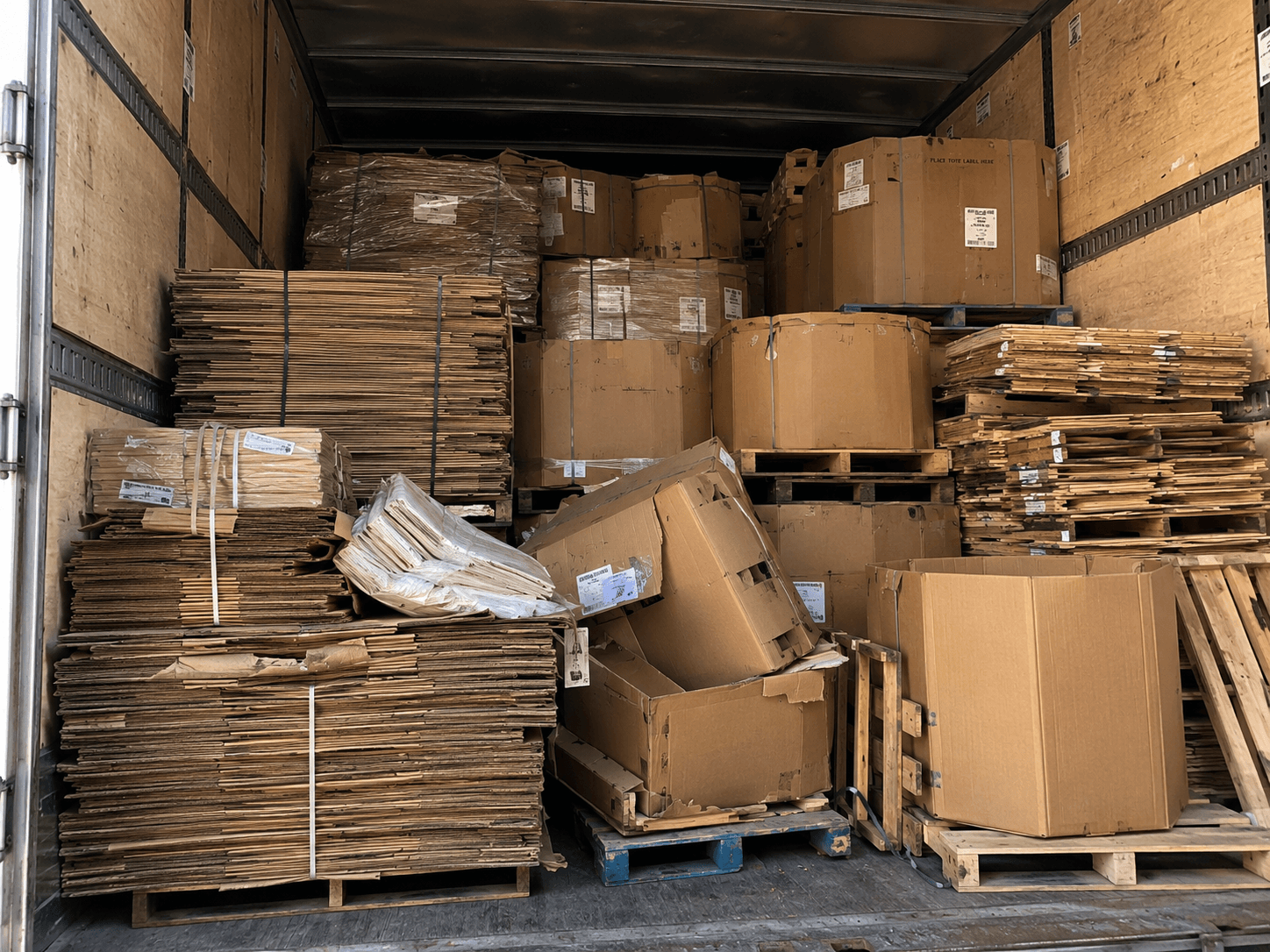
Even the loads that can't ship again stay in the loop.
A trailer of mixed returns is not a disposal problem — it is raw material. Whatever cannot be resold or reconditioned is upcycled into plastic-free dunnage and protective goods. The landfill line stays at zero because there is always a higher rung to send material to.
Diversion data, plastic-free dunnage, and export-ready compliance.
Sustainability claims only count when someone can audit them. Here is exactly what we document and supply, so the reuse-first choice strengthens your disclosures instead of complicating them.
Per-account diversion
Units and tonnage split by outcome — reused, reconditioned, upcycled, recycled — with landfill at zero. Formatted to lift straight into an ESG or CSR report.
Plastic-free by default
Void fill, dunnage and protective packaging made from spent corrugated — curbside-recyclable and foam-free, so your shipment stays inside the loop end to end.
ISPM-15 pallets
Heat-treated, ISPM-15 stamped pallets for international freight, so choosing reuse never creates a phytosanitary or customs headache at the border.
Frequently asked questions
Why is reuse better than recycling?
Recycling corrugated back into fiber uses water and energy and shortens the fiber every cycle, so it can only be recycled a finite number of times. Reuse skips all of that: the same box does the same job again with essentially no reprocessing. That is why our model puts reuse first and treats recycling as the last responsible step, not the goal.
Can you give me diversion data for my ESG report?
Yes. We track tonnage reused versus recycled on a per-account basis and can provide diversion reporting your sustainability team can cite in ESG and CSR disclosures. It is documented, not estimated.
Is your upcycled dunnage plastic-free?
Our upcycled goods are made from genuinely spent corrugated — plastic-free protective packaging, void fill and dunnage that replaces foam and bubble film with a curbside-recyclable, paper-based alternative.
Are your pallets ISPM-15 compliant?
We supply heat-treated, ISPM-15 stamped pallets suitable for international shipment, so your reuse-first choice does not create a customs or phytosanitary headache.
How do you actually hit zero to landfill?
Every load is graded on arrival. What can be resold is resold; what can be reconditioned is restored; what is truly spent becomes upcycled goods or goes to recycling. There is simply no path in our workflow that ends at a landfill.
How do you calculate the CO₂e a reused box avoids?
Avoided emissions come from two places: the manufacturing we prevent (a reused box means a new one was not produced, so its cradle-to-gate fiber, water and energy footprint never happens) and the reprocessing we defer (each reuse cycle postpones the pulping that recycling requires). We attribute the avoided manufacturing footprint to reuse and count recycling only as the final, lower-value step. Because we measure counts and tonnage by grade, the estimate is grounded in real throughput rather than a blanket assumption.
What exactly is in the diversion report you provide?
A per-account summary of units and tonnage handled, split into reused (resold as-is), reconditioned, upcycled and recycled — with the landfill line reading zero. It is the kind of documented, category-by-category breakdown a sustainability team can lift directly into an ESG or CSR disclosure without having to estimate.
Does buying reused boxes really lower our Scope 3 footprint?
Reused packaging typically carries a far smaller embodied footprint than new corrugated, because the energy- and water-intensive step — making the board — has already happened once and is being amortized over multiple lives. Sourcing used before new is one of the simplest levers available on packaging-related Scope 3 emissions, and we give you the numbers to show it.
Why plastic-free dunnage instead of foam or bubble film?
Plastic void fill and foam are effective but hard to recycle and slow to break down, so they tend to end up in a landfill regardless of how the box around them is handled. Paper-based upcycled dunnage protects goods just as well for most freight, is curbside-recyclable, and keeps the whole shipment inside the circular loop instead of leaking plastic out the bottom of it.